
 China
China English
High-Speed Silent TLJ-Type Drag Chain
Keywords:
Classification:
Details
Product Introduction
High-speed silent energy chains are injection-molded from glass-fiber-reinforced nylon, offering lightweight operation and virtually noise-free performance. Resembling a tank track, they consist of numerous modular links that rotate smoothly relative to one another. Within the same series, all nylon energy chains share the same internal height, external height, and pitch; however, the internal height and bending radius R can be customized. Each modular link comprises left and right side plates as well as upper and lower cover plates. The links can be opened individually, making assembly and disassembly quick and easy—there’s no need to thread cables through the chain. Simply open the cover plate to insert cables, hydraulic hoses, pneumatic lines, and other components directly into the energy chain. Optional partition inserts are also available to divide the internal space according to specific requirements.
Product Features
01
Safety cable ties
02
Quiet Operation
03
Aesthetically pleasing
04
Extremely low resistance
Product Advantages
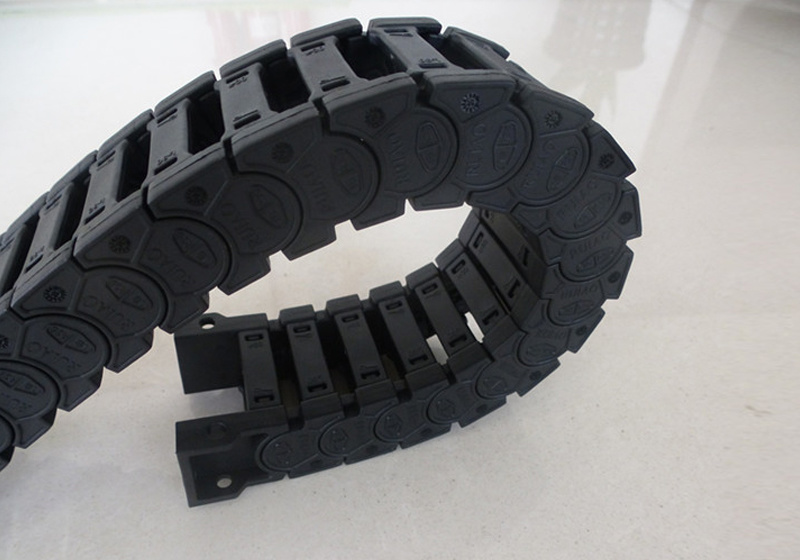
● The high-speed, silent drag chain is manufactured using a special process, enabling it to operate reliably under high-speed conditions. It is primarily used on machinery such as CNC lathes and robotic systems that require rapid motion, ensuring that no unnecessary contamination occurs during the production process. Additionally, it effectively safeguards the safe operation of flexible conduits, hydraulic lines, pneumatic hoses, and cables in high-speed environments.
● Expanded application scope for high-speed, low-noise energy chains: 1. Requires extremely quiet operation; 2. Suitable for high speeds and/or high acceleration; 3. Capable of withstanding large thrust and tensile forces; 4. Designed for small bend radii; 5. Reduces vibration; 6. Minimizes wear.
Product Specifications
| Model | Inner height (mm) | Optional inner width (mm) | Optional bending radius | Pitch | Type |
| TLJ18K Series | 18 | 20.30.40.50.60 | 38 | 16 | Bridge-type |
| TLJ28K Series | 28 | 31.51.76.101.121 | 55.75.100 | 24 | Bridge-type |
| TLJ38K Series | 38 | 51.76.101.151.176 | 75.100.125.150.200 | 30 | Bridge-type |
| TLJ38F Series | 38 | 51.76.101.151.176 | 125.150.200 | 30 | Closed |
| TLJ48K Series | 48 | 51.76.101.126.151.176 | 125.150.200.250 | 35 | Bridge-type |
| TLJ48F Series | 48 | 51.76.101.126.151.176 | 150.200.250 | 35 | Closed |
| TLJ58K Series | 58 | 75.100.125.150.175.200 | 115.150.175.200.250.300.350 | 40 | Bridge-type |
| TLJ58F Series | 58 | 75.100.125.150.175.200 | 200.250.300.350 | 40 | Closed |
Scope of Application
The high-speed, low-noise TLJ-type drag chain is suitable for all types of drive systems, including engraving machines, printing equipment, and robotic automation. It can be freely extended or shortened, operates smoothly and quietly, and runs with exceptional ease.
How to Identify the Quality of Plastic Drag Chains
| Good drag chain | Poor cable carrier | |
 |
 |
|
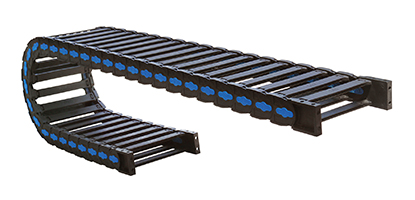
| A quick look | View the overall appearance of the nylon cable carrier. The cable carrier boasts a refined appearance and meticulous workmanship, with excellent material quality, a smooth and even surface finish, and an overall aesthetically pleasing effect, while exhibiting minimal deformation. |
View the overall effect of the drag chain. Poor-quality drag chains have a rough, poorly finished appearance, uneven coloration, and an unappealing visual effect, with significant deformation. |
| Second touch | Touch the surface, edges, and inner walls of the drag chain with your hand. The nylon cable carrier has a smooth surface that feels non-abrasive; it rotates smoothly and effortlessly with minimal friction. |
Touch the surface, edges, and inner walls of the drag chain with your hand. A poor-quality drag chain has a rough, uneven surface that feels prickly to the touch; it also feels heavy and cumbersome when rotating, with significant friction. |
| Three Smells | Smell the odor; listen for the sound produced when tapping the drag chain in areas with higher hardness. A properly hammered drag chain produces a relatively deep, muffled sound and feels solid and heavy; it also has no noticeable odor. |
Smell the odor; listen for the sound produced when tapping the drag chain in areas with higher hardness. When you tap a low-quality plastic cable carrier, the sound is crisp and relatively hollow and light; it also has a strong, pungent odor. |
| Four rubs | Use external force to vigorously rub the surface of the plastic cable carrier. It is relatively labor-intensive to roll up the drag chain, and the resulting debris is very fine, resembling powder. Cut open the product to examine the cross-section of the drag chain. |
Use external force to vigorously rub the surface of the plastic cable carrier. Poor-quality drag chains tend to develop pitting, with debris appearing in granular form; cut open the product to examine the drag chain’s cross-section. |
| Five cuts | Cut open the product to examine the cross-section of the nylon cable carrier. A well-made drag chain exhibits a neat, uniform cross-section with no obvious delamination. |
Cut open the product to examine the cross-section of the energy chain. A poorly manufactured drag chain will exhibit distinct layers and clearly visible striations in its cross-sectional cut. |
| Six Considerations | Evaluate the product's cost-effectiveness. High-quality drag chains are relatively expensive, have a long service life, can handle heavy loads, and offer excellent wear resistance. |
Evaluate the product's cost-effectiveness. Poor-quality drag chains are inexpensive, have a shorter service life, can handle only light loads, exhibit poor wear resistance, and require more frequent replacement. |
Inquiry



7X24h response·makes you feel at ease
Service hotline
Add:Zhifangtou Industrial Estate, Cangzhou, Hebei, China
Cell phone:86-13785751663
86-13785766281
Tel:86-317-4958902 / 86-317-4958903
E-mail:wx@ruiaojijian.com

Scan and consult customer service