
 China
China English
Paper Belt Filter
Keywords:
Classification:
Details
Product Details
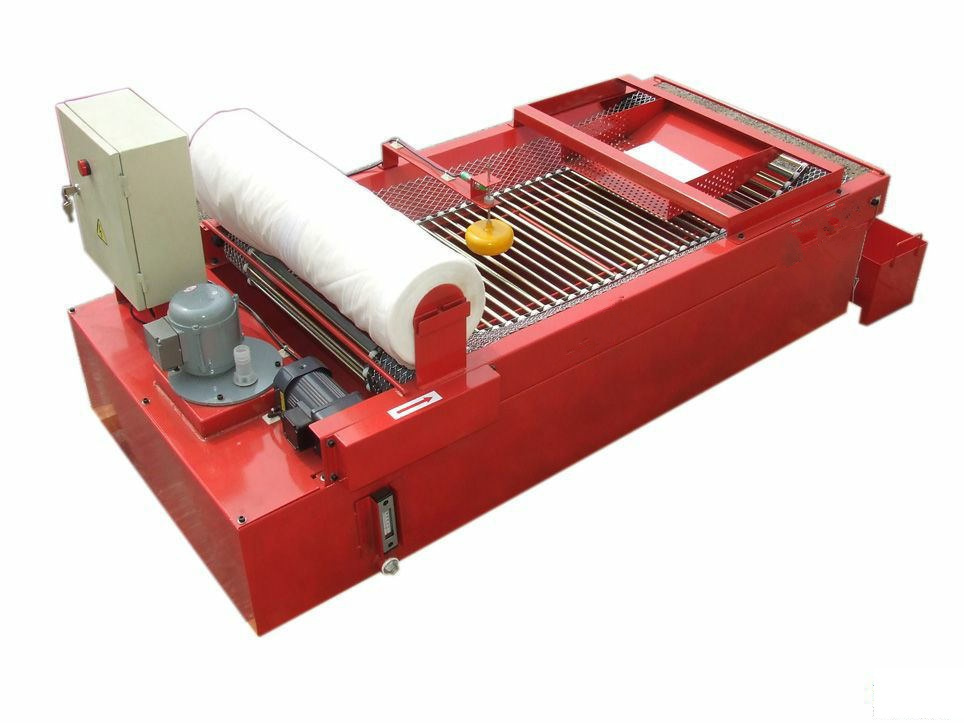
The paper-belt filter consists primarily of the following components: a liquid tank, a dirty-paper collection bin, a nonwoven filtration medium (commonly referred to as the “paper belt”), a drive mechanism, an alarm unit, a reducer, and a liquid pump. During operation, the chain and wire mesh of the drive mechanism are arranged in an arcuate configuration, and the nonwoven fabric laid over them also assumes an arcuate shape. When contaminated liquid containing impurities is sprayed onto the nonwoven fabric, fine chips and other contaminants are adsorbed onto its surface. As the accumulated dirt on the fabric increases and eventually clogs it, the liquid level rises, triggering the float-type level controller to send a signal. The alarm unit then activates, causing the reducer to drive the chain and wire mesh, which in turn discharges the accumulated dirt and used fabric into the dirty-paper collection bin. This automatically completes the replacement of the filter cloth. Once the filter cloth has been renewed and the liquid level drops, the machine stops rotating, initiating the next filtration cycle. The clarified liquid entering the liquid tank is then pumped by the liquid pump to the main processing unit.
The filter manufacturer’s products are capable of thoroughly removing all types of metallic and non-metallic fine impurities from coolant (oil), making them particularly suitable for precision machining equipment such as grinding machines and honing machines. When contaminated fluid contacts the filter cloth, fine chips and impurities are adsorbed onto the cloth, where they themselves contribute to the filtration process by forming part of the filter layer, thereby enhancing the filtration efficiency. Moreover, because the filter cloth operates on a curved surface, this not only increases the effective filtration area but also reduces the footprint. When the filtered liquid contains a high concentration of magnetically attractable impurities, a two-stage filtration system can be implemented by adding a magnetic separator: first, the separator removes the majority of these magnetic impurities, followed by filtration through the filter cloth. This approach effectively reduces filter cloth consumption and improves overall filtration performance.
Features of the Paper Belt Filter
01
The paper-band filter is highly effective at removing fine metallic and non-metallic impurities from coolant (oil), making it particularly suitable for precision machining centers such as grinders and honing machines.
02
When contaminated liquid falls onto the filter cloth, fine chips and impurities are adsorbed onto its surface; in turn, these particles themselves become part of the filtration layer, thereby enhancing the filter cloth’s filtration performance.
03
Because the filter cloth operates on a curved surface, it both increases the filtration area and reduces the footprint.
04
When the liquid to be filtered contains a high concentration of magnetically attractable impurities, a two-stage filtration system can be implemented by adding an additional magnetic separator: first, the magnetic separator removes most of the magnetically attractable impurities, and then the remaining particles are filtered through a filter cloth. This approach effectively reduces filter-cloth consumption and improves filtration performance.
Advantages of Paper Belt Filters
● Hebei Rui’ao’s filtration equipment is shipped to you via land transportation. Our products are primarily made of metal and come with a five-year warranty, making them reliable mechanical hardware supplies you can purchase with confidence.
● Our company’s paper-bag filters accept bank transfers and Alibaba.com payment methods. Once payment is received, we will ship within 15 days. Should any issues arise with our products, please feel free to contact us by phone for assistance; we are committed to providing high-quality after-sales service.
Scope of Application
Hebei Rui’ao’s belt-type paper filter machines are particularly well suited for purifying coolant used in various grinding machines, precision lapping machines, wire-drawing machines, electrical machining equipment, and other fine-machining tools; their most common application is the separation of metal chips and swarf. Magnetic separators, on the other hand, are primarily targeted at the machine-tool market—specifically for chip and swarf separation in lathes, grinders, planers, and other machining operations—and can also be employed in processes that require iron removal, such as the treatment of industrial waste and chemical intermediates. With the increasing use of aluminum products in the market, the volume of aluminum chips generated has inevitably grown, and if ferrous contaminants are present, these chips cannot be properly recycled or reused; this is precisely when magnetic separators come into play. Magnetic separators are also widely used in the refining of copper powder and other nonferrous metals. Commonly applicable machinery includes surface grinders, precision grinders, deep-hole drilling machines, honing machines, internal and external cylindrical grinders, centerless grinders, thread/gear/bearing grinders, wire-cutting machines, and machining centers.
Performance and Applications of Magnetic Roller Belt Filters
This unit is a combined product of a paper-band filter and a magnetic separator, and should be given priority when machining magnetizable workpieces on grinding equipment.
Features of the Magnetic Roller Belt Filter
01
Compact structure, low noise, and low power consumption.
02
It enables dual-stage filtration of cutting fluid, extending its service life and improving workpiece machining quality.
Previous:
Inquiry



7X24h response·makes you feel at ease
Service hotline
Add:Zhifangtou Industrial Estate, Cangzhou, Hebei, China
Cell phone:86-13785751663
86-13785766281
Tel:86-317-4958902 / 86-317-4958903
E-mail:wx@ruiaojijian.com

Scan and consult customer service